

The Children Of Violent Rome 1976 ITA SUB ENG 1080p BluRay x264
- Category Movies
- Type HD
- Language Italian
- Total size 13.5 GB
- Uploaded By BoogerSan
- Downloads 168
- Last checked 1 month ago
- Date uploaded 1 month ago
- Seeders 12
- Leechers 16

The Children of Violent Rome
In the gritty underbelly of 1970s Rome, the harsh reality of Neo-Nazi youth, living in the shadow of societal decay, is exposed. A group of disillusioned teenagers from the outskirts of the city, whose lives are shaped by violence, crime, and their environment, navigate their turbulent existence, finding themselves entangled in a deadly cycle of lawlessness and rebellion.

Year: 1976
Country: Italy
Director: Renato Savino
Cast: Gino Milli, Cristina Businari, Emilio Locurcio, Mario Cutini
IMBD: Link
Language : Italian
Subtitles : English

On September 29, 1975, two young girls—17-year-old Donatella Colasanti and her 19-year-old friend Rosaria Lopez—were lured to a villa by the sea in San Felice Circeo, a couple of hours from Rome, then systematically beaten, raped and tortured for 36 hours by a trio of upper class youths, Angelo Izzo, Gianni Guido and Andrea Ghira. Rosaria didn’t survive the ordeal, while Donatella— who was first partially strangled, then repeatedly beaten in the head with an iron bar—pretended to be dead. The assassins wrapped her in a plastic bag, threw her into the trunk of Guido’s Fiat 127 together with Rosaria’s body, got back to Rome, parked the car just in front of Guido’s house and left. Donatella’s feeble screams caught a policeman’s attention: a picture taken by a photographer in the moment she was finally released from the trunk shows a young girl—naked, covered in blood and bruises—with her eyes wide open in fear, and the expression of someone who has been to hell and back.
Gianni Guido was arrested immediately afterwards, while he was wandering near the car in a state of apparent mental confusion (he likely heard Donatella’s screams and wanted to give her the finishing stroke). Angelo Izzo was also caught within a few hours, while Andrea Ghira fled. Soon the police found out that Gianni Guido was a member of the Neofascist Roman youth, while Izzo was out on parole after a conviction for rape. After a quick trial, Guido and Izzo were found guilty and sentenced to life imprisonment on July 29, 1976.
The so-called “Circeo massacre” caused a sensation, filling newspaper headlines for months and causing a fury amidst the public opinion, mostly because those violent events overturned the bourgeois stereotypes of the good-natured, clean-cut youth as opposed to morally reproachable long-haired, low-life proletarians. How could it be that those horrible acts were the product of upper-class youngsters, the sons of well esteemed families? What’s more, the public was stricken by the arrogant, contemptuous attitude displayed by Guido and Izzo during the trial, as they claimed their “sexual, class and wealth supremacy that gave them the right to use and abuse” of their victims, as journalist Lietta Tornabuoni wrote in Il Corriere della Sera, labeling them the “Children of Bad Rome”: “Handsome faces, fashion sweaters, beautiful cars, beautiful homes, beautiful summers: and behind all this, all the black swarm that turns a young man into a murderer. The addiction to violence that they acquired in the Fascist youth organizations they belong to […], the violence chosen as self- affirmation and ideology. The arrogance of money and the contempt towards women, especially the poorest […]. The void of fanciful lives, torpid, dominated by boredom, spoilt by comfort, without any hint of morality.”
The Circeo massacre and the following trial offered a significant portrayal of Italian society at that time. The feminist movements would take it as an example of violence towards women, the assassins’ political connotation brought to the foreground the militant Anti-fascism. The Roman fascist groups, comprised of upper-class youth from the wealthy Parioli district (the so-called “Pariolini”) who loved Land Rovers, martial arts and punitive expeditions against left-wing students, were similar to Milan’s “Sanbabilini” (as depicted in Carlo Lizzani’s San Babila 8 P.M.) and Turin’s “Cabinotti.” The Circeo massacre seemed to draw once again a line between the good and the bad, the left and the right. Just a month later, on November 2, 1975, Pier Paolo Pasolini was savagely murdered in Ostia. Those two events became two spectacular and chilling pictures of contemporary Italy, where the absorption of the middle class and the subproletarians prophesied by Pasolini fatally happened, and manifested itself through cruel rituals of extreme violence.
As Pasolini told his friend, journalist Furio Colombo, just a few hours before his death: “The Circeo killers were desperately looking for a uniform, a disguise. They would have given anything to have an order, a reason, an idea to give their massacre a sense. They didn’t know, but they were already in disguise. Disguised as new assassins.” In his collection of essays Lutheran Letters, Pasolini also wrote: “It has been television which in practical terms (it is merely a means) has brought to a close the age of pity and begun the age of hedone. It is an age in which young people, who are at one and the same time presumptuous and frustrated, because of the stupidity and the unattainability of the models offered by school and television, in a way that cannot be checked tend to be either aggressive to the point of delinquency or passive to the point of unhappiness (which is no less a crime).
The Circeo massacre was an irresistible catalyst for Italian cinema. Those references to real-life events which popped up now and then in so many films that only marginally dealt with the problems of youth, concentrated in a number of films—I ragazzi della Roma violenta, Terror in Rome, and more marginally Roma, l’altra faccia della violenza and Come cani arrabbiati—that used the event as an exemplary parable of the state of a generation whose behavior was becoming incomprehensible for the older ones. The results were equally emblematic, mainly for the resort to excess and visual shock that characterized genre cinema.
Renato Savino’s I ragazzi della Roma violenta—a title that blatantly emulated Marino Girolami’s Violent Rome (Roma Violenta)—was released to theaters in April 1976, when the trial was still in course. The cast was filled with little-known names: the most popular of the lot, Gino Milli, had enjoyed a short-lived bout of marginal exposition a few years earlier, while the female lead Cristina Businari had been 1967’s Miss Italy. Bearded, chubby character actor Marco Zuanelli was a recurring presence in Z-grade Westerns, while Gino Barzacchi was a rather popular bodybuilder.
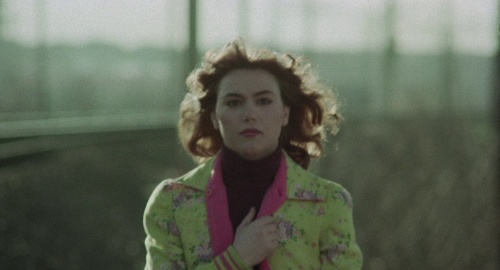
Savino’s point of view is blatant since the very beginning: I ragazzi della Roma violenta sports a semi-documentary prologue where a journalist interviews passers-by—all are in favor of death penalty—and ends with an on-screen line that goes as follows: “All this can really happen and involve you and your family … what are you doing to prevent it?.” The plot juxtaposes two violent gangs, one formed by upper-class youths and the other by proletarians, in a misguided attempt at a social portrayal. Yet, despite the film’s claims at depicting the period’s negative feelings, I ragazzi della Roma violenta often falls headfirst into the grotesque—as shown by the character of the upper-class neo–Nazi who gets sexually aroused only when he plays pinball—and turns any attempt at a sociological discourse into awkwardly conceived metaphors and episodes. Marco’s (Gino Milli) absent-minded parents are never shown in face, as to underline their inability to educate their son, while the latter’s nebulous state of mind is exemplified in a scene at the restaurant where Marco
refuses to read the list but can’t decide what he wants to eat.
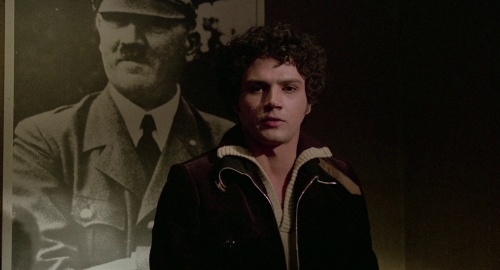
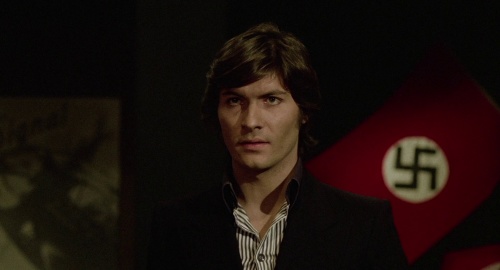
Savino, who usually signed his film as “Mauro Stefani,” had written a handful of Westerns (including Margheriti’s Vengeance) and directed a few little-seen sexploitation affairs such as Grazie signore p… (1972), Decameron ’300 (1973) and Mamma … li turchi! (1973). On I ragazzi della Roma violenta, crude filmmaking is accompanied by a constant unpleasantness that borders on misanthropy. There is no room for love, friendship or mercy whatsoever. The anarchist professor whom the fascists mock and beat is ultimately just a caricature; Marco masturbates while reading a hard-boiled novel; the upper-class Nazi kids gather in a flat decorated by swastikas and giant Hitler portraits, where they unconsciously emulate their parents’ social rituals and follow to the letter absurd sets of rules. On the other hand, the proletarian kids ape the former’s violent acts, going so far as staging another gang- rape like the one perpetrated by their role models. “What I wanted to stress, yet nobody understood” Savino justified, “was the relationship between the boys of upper-class Rome and the subproletarians who emulated them, like “we can do that, too!” 5 However, the depiction of the lower-class delinquents often falls into the unintentionally hilarious, although Savino seemingly draws inspiration from Pasolini’s prophecies on the anthropological mutation of the subproletarians, with the transition from an imposed-upon ideology (Fascism) to another that is passively accepted (consumerism). Everything revolves around sex, food, money. Women are commodities, to be taken and used like a motorbike or a roasted chicken. Salò, or the 120 Days of Sodom did not come unnoticed.
However, the film’s revolting misogyny has nothing to do with Pasolini’s disconsolate awareness: the sequence where the Circeo massacre is re-enacted does not spare the viewer any detail, as unpleasant as it can be (one of the victims is drowned in an aquarium while she’s being raped, similarly to Rosaria Lopez), while the crude rape scenes are accompanied by the victims’ interior monologues, where the women appear to enjoy the violence they are being subjected to. A Neofascist girl raped by three working-class youth even states: “It’s this violence that really turns us on … you obviously don’t understand a thing about women!” The least said, the better….
The story of Gianni Guido and Angelo Izzo did not end with their trial. The two criminals tried to escape in 1977, taking a prison guard as hostage, but were stopped. In 1980 Guido had his imprisonment reduced to 30 years, after he “repented” and his family found an economical agreement with Rosaria Lopez’ parents. He was transferred to another prison and was granted a privileged treatment. He escaped from jail on January 25, 1981. Two years later, on January 28, 1983, Guido was arrested in Buenos Aires, where he had become a car seller under a fake name. He escaped again on April 15, 1985, and was arrested in Panama in June 1994. Angelo Izzo escaped from the Alessandria prison on August 25, 1993, and was arrested in France on September 15. He obtained probation in 2004, and in 2005 his name ended again on the headlines because of a ferocious double murder: in 2007 he was sentenced to life imprisonment. Little is known about Andrea Ghira: in November 2005 the Ministry of Interior announced that he had died in 1994 of an overdose in Morocco, where he had enlisted the foreign Legion in 1976. Donatella Colasanti died, at 47, of breast cancer, on December 30, 2005. On April 11, 2008 Gianni Guido was entrusted to social services. He was released from prison on August 25, 2009, the beneficiary of a pardon. (Roberto Curti)

[ About file ]
Name: The Children Of Violent Rome.Renato Savino.1976.BluRay.PiG30N.mkv
Date: Tue, 25 Nov 2025 12:08:22 +0100
Size: 14,455,508,573 bytes (13785.847257 MiB)
[ Magic ]
File type: Matroska data
File type: EBML file, creator matroska
[ Generic infos ]
Duration: 01:29:18 (5358.421 s)
Container: matroska
Production date: Tue, 25 Nov 2025 09:23:42 +0100
Total tracks: 6
Track nr. 1: video (V_MPEG4/ISO/AVC) {und}
Track nr. 2: audio (A_FLAC) {ita}
Track nr. 3: audio (A_AAC) [Commentary by Film Historian Eugenio Ercolani and Film Critic Nanni Cobreti] {eng}
Track nr. 4: audio (A_AAC) [Commentary by Film Critic Rachael Nisbet] {eng}
Track nr. 5: subtitle (S_TEXT/UTF8) [OCR] {eng}
Track nr. 6: subtitle (S_HDMV/PGS) [PGS] {eng}
Muxing library: libebml v1.4.5 + libmatroska v1.7.1
Writing application: mkvmerge v96.0 ('It's My Life') 64-bit
[ Relevant data ]
Resolution: 1920 x 1036
Width: multiple of 32
Height: multiple of 4
Average DRF: 21.391159
Standard deviation: 2.7863
Std. dev. weighted mean: 2.760867
[ Video track ]
Codec ID: V_MPEG4/ISO/AVC
Resolution: 1920 x 1036
Frame aspect ratio: 480:259 = 1.853282 (~1.85:1)
Pixel aspect ratio: 1:1 = 1
Display aspect ratio: 480:259 = 1.853282 (~1.85:1)
Framerate: 23.976024 fps
Stream size: 14,064,503,455 bytes (13412.955718 MiB)
Duration (bs): 01:29:18 (5358.352957 s)
Bitrate (bs): 20998.24863 kbps
Qf: 0.440296
[ Audio track nr. 1 ]
Codec ID: A_FLAC
Sampling frequency: 48000 Hz
Channels: 2
Sample size: 16-bit
[ Audio track nr. 2 ]
Codec ID: A_AAC
Sampling frequency: 48000 Hz
Channels: 2
Stream size: 58,435,098 bytes (55.728052 MiB)
Bitstream type (bs): AAC LC (Low Complexity)
Frames (bs): 251,176
Duration (bs): 01:29:18 (5358.421333 s)
Chunk-aligned (bs): Yes
Bitrate (bs): 87.242259 kbps VBR
Sampling frequency (bs): 48000 Hz
Mode (bs): 2: front-left, front-right
[ Audio track nr. 3 ]
Codec ID: A_AAC
Sampling frequency: 48000 Hz
Channels: 2
Stream size: 61,281,141 bytes (58.44225 MiB)
Bitstream type (bs): AAC LC (Low Complexity)
Frames (bs): 251,176
Duration (bs): 01:29:18 (5358.421333 s)
Chunk-aligned (bs): Yes
Bitrate (bs): 91.491336 kbps VBR
Sampling frequency (bs): 48000 Hz
Mode (bs): 2: front-left, front-right
[ Video bitstream ]
Bitstream type: MPEG-4 Part 10
User data: x264 | core 164 (DJATOM's mod) | H.264/MPEG-4 AVC codec
User data: Copyleft 2003-2022 | http://www.videolan.org/x264.html | cabac=1
User data: ref=4 | deblock=1:-2:-2 | analyse=0x3:0x133 | me=umh | subme=11
User data: psy=1 | fade_compensate=0.00 | psy_rd=0.60:0.10 | mixed_ref=1
User data: me_range=32 | chroma_me=1 | trellis=2 | 8x8dct=1 | cqm=0
User data: deadzone=6,6 | fast_pskip=0 | chroma_qp_offset=-3 | threads=32
User data: lookahead_threads=8 | sliced_threads=0 | nr=0 | decimate=0
User data: interlaced=0 | bluray_compat=0 | constrained_intra=0 | bframes=16
User data: b_pyramid=2 | b_adapt=2 | b_bias=0 | direct=3 | weightb=1
User data: open_gop=0 | weightp=2 | keyint=250 | keyint_min=23 | scenecut=40
User data: intra_refresh=0 | rc=2pass | mbtree=0 | bitrate=21000 | ratetol=1.0
User data: qcomp=0.70 | qpmin=0 | qpmax=69 | qpstep=4 | cplxblur=20.0
User data: qblur=0.5 | ip_ratio=1.10 | pb_ratio=1.10 | aq=3:0.80
SPS id: 0
Profile: High@L4.1
Num ref frames: 4
Chroma format: YUV 4:2:0
PPS id: 0 (SPS: 0)
Entropy coding type: CABAC
Weighted prediction: P slices - explicit weighted prediction
Weighted bipred idc: B slices - implicit weighted prediction
8x8dct: Yes
Total frames: 128,472
Drop/delay frames: 0
Corrupt frames: 0
P-slices: 23111 ( 17.989 %) ####
B-slices: 104774 ( 81.554 %) ################
I-slices: 587 ( 0.457 %)
SP-slices: 0 ( 0.000 %)
SI-slices: 0 ( 0.000 %)
[ DRF analysis ]
average DRF: 21.391159
standard deviation: 2.7863
max DRF: 33
DRF<5: 0 ( 0.000 %)
DRF=5: 1 ( 0.001 %)
DRF=6: 7 ( 0.005 %)
DRF=7: 20 ( 0.016 %)
DRF=8: 0 ( 0.000 %)
DRF=9: 0 ( 0.000 %)
DRF=10: 2 ( 0.002 %)
DRF=11: 8 ( 0.006 %)
DRF=12: 57 ( 0.044 %)
DRF=13: 147 ( 0.114 %)
DRF=14: 507 ( 0.395 %)
DRF=15: 1683 ( 1.310 %)
DRF=16: 2772 ( 2.158 %)
DRF=17: 5319 ( 4.140 %) #
DRF=18: 7762 ( 6.042 %) #
DRF=19: 10176 ( 7.921 %) ##
DRF=20: 15928 ( 12.398 %) ##
DRF=21: 19890 ( 15.482 %) ###
DRF=22: 20431 ( 15.903 %) ###
DRF=23: 17836 ( 13.883 %) ###
DRF=24: 10998 ( 8.561 %) ##
DRF=25: 7053 ( 5.490 %) #
DRF=26: 4161 ( 3.239 %) #
DRF=27: 1873 ( 1.458 %)
DRF=28: 881 ( 0.686 %)
DRF=29: 485 ( 0.378 %)
DRF=30: 206 ( 0.160 %)
DRF=31: 95 ( 0.074 %)
DRF=32: 65 ( 0.051 %)
DRF=33: 5 ( 0.004 %)
DRF>33: 0 ( 0.000 %)
P-slices average DRF: 20.611397
P-slices std. deviation: 2.761431
P-slices max DRF: 33
B-slices average DRF: 21.569454
B-slices std. deviation: 2.760577
B-slices max DRF: 33
I-slices average DRF: 20.267462
I-slices std. deviation: 2.790532
I-slices max DRF: 30
[ Edition entry ]
UID: 14576711205387072869
Hidden: No
Selected by default: No
Playlist: No
Chapters:
00:00:00,000-00:15:00,858: Start {und}
00:15:00,858-00:29:21,760: The Gang {und}
00:29:21,760-00:43:08,586: The Children {und}
00:43:08,586-00:57:23,690: The Teacher {und}
00:57:23,690-01:12:33,265: Delinquency {und}
01:12:33,265-01:28:09,325: The End {und}
01:28:09,325-01:29:18,421: Credits {und}
This report was created by AVInaptic (01-11-2020) on 29-11-2025 03:08:20


Files:
- The Children Of Violent Rome.Renato Savino.1976.BluRay.PiG30N.mkv (13.5 GB)
There are currently no comments. Feel free to leave one :)
Code:
- udp://tracker.opentrackr.org:1337/announce
- udp://tracker.torrent.eu.org:451/announce
- udp://open.stealth.si:80/announce
- udp://tracker.tiny-vps.com:6969/announce
- http://tracker.bt4g.com:2095/announce
- udp://tracker.dler.org:6969/announce
- http://tracker.renfei.net:8080/announce
- https://tracker.tamersunion.org:443/announce
- udp://explodie.org:6969/announce
- https://trackers.mlsub.net:443/announce
- udp://exodus.desync.com:6969/announce
- udp://p4p.arenabg.com:1337/announce
- udp://opentracker.io:6969/announce
- udp://d40969.acod.regrucolo.ru:6969/announce